
ACULT
Abstraction Clarity Understanding Learning Template

“A poet once said, 'The whole universe is in a glass of wine.' We will probably never know in what sense he meant it, for poets do not write to be understood. But it is true that if we look at a glass of wine closely enough we see the entire universe. There are the things of physics: the twisting liquid which evaporates depending on the wind and weather, the reflection in the glass; and our imagination adds atoms. The glass is a distillation of the earth's rocks, and in its composition we see the secrets of the universe's age, and the evolution of stars. What strange array of chemicals are in the wine? How did they come to be? There are the ferments, the enzymes, the substrates, and the products. There in wine is found the great generalization; all life is fermentation. Nobody can discover the chemistry of wine without discovering, as did Louis Pasteur, the cause of much disease. How vivid is the claret, pressing its existence into the consciousness that watches it! If our small minds, for some convenience, divide this glass of wine, this universe, into parts -- physics, biology, geology, astronomy, psychology, and so on -- remember that nature does not know it! So let us put it all back together, not forgetting ultimately what it is for. Let it give us one more final pleasure; drink it and forget it all!”
― Richard P. Feynman
Do large language models understand what they are saying?
Does reasoning allow llm’s to ‘think’.
Will machines ever ‘understand’ what they have been trained on?
These were questions that stayed back with me after a debate on “Is cognition computation?”
While there are good arguments for large parts of those questions, most people can’t agree on what it really means to understand something. When we say we understand something, what do we mean?
Is it the ability to simplify something, explain it in as simple way as possible?
Is it applying the concept in various circumstances?
Is it knowing the limits of the thing we are understanding under different contexts?
It’s a hard question. One for which, I’ve built some intuition and a perspective that I will attempt to share here.
From noise to understanding
Let’s start from the beginning when there is nothing. Hmm, that not quite right. Ever since we are born and rather even before we are born, we start learning. By the time we’re conscious of it, our minds are already full of information: some reusable, some not.
Still, there are moments when we encounter something genuinely new—or when existing understanding needs to be updated. And in those moments, some interesting patterns begin to appear.
Early on, everything matters.
Small changes feel important.
New examples feel surprising.
Edge cases feel overwhelming.
But as learning progresses, something shifts.
Different inputs start to feel the same.
New examples stop adding much to your understanding.
You recognize the situation before thinking about it.
Things start to click and it’s easier to grok the incoming stream of input and information.
Abstraction as what survives change
I think of this stage as forming a good abstraction.
I think of abstraction as what remains stable when details vary and inputs change. To me an abstraction is not entirely a summary or a simplification. It’s not less information. It’s a pattern that keeps working even when the surface changes.
When you abstract, you are no longer tied to a specific instance. You’re operating at a level where many situations map to the same understanding. You can now apply that same abstraction to new situations as long as the abstraction remains invariant to the core concepts of that abstraction.
Why this feels like compression (but isn’t really)
At first I described and thought of this process as “compression”. It made sense intuitively.
Many experiences → one understanding
Many examples → one idea
Many paths → one conclusion
But what’s really happening isn’t that information is being thrown away. It’s that some distinctions stop mattering. You could still notice them. You just don’t need to.
We have at this point built a structure, a mental model, an invariant structure that holds when we subject our understanding to new variations of the concept or inputs. (Until it doesn’t and we need to update our understanding but for the most part it holds.)
That subjective experience—when noise fades and structure stands out—is what I call clarity.
Clarity as a learning milestone
Clarity is not a mechanism. It’s a feeling.
It’s the moment when:
new examples feel redundant
variations no longer confuse you
you can explain the idea simply
Clarity is how abstraction shows up internally.
It’s the sign that learning has reorganized experience around what matters.
Understanding as a stable internal state
This is how I think of understanding.
Understanding isn’t simplification. It is not accuracy or performance on a benchmark for machines or humans on tests.
It isn’t memorization.
Understanding is stability.
You understand something when:
small changes don’t break your reasoning
unfamiliar cases still feel navigable
the idea transfers to new contexts
Understanding is what allows learning to generalize.
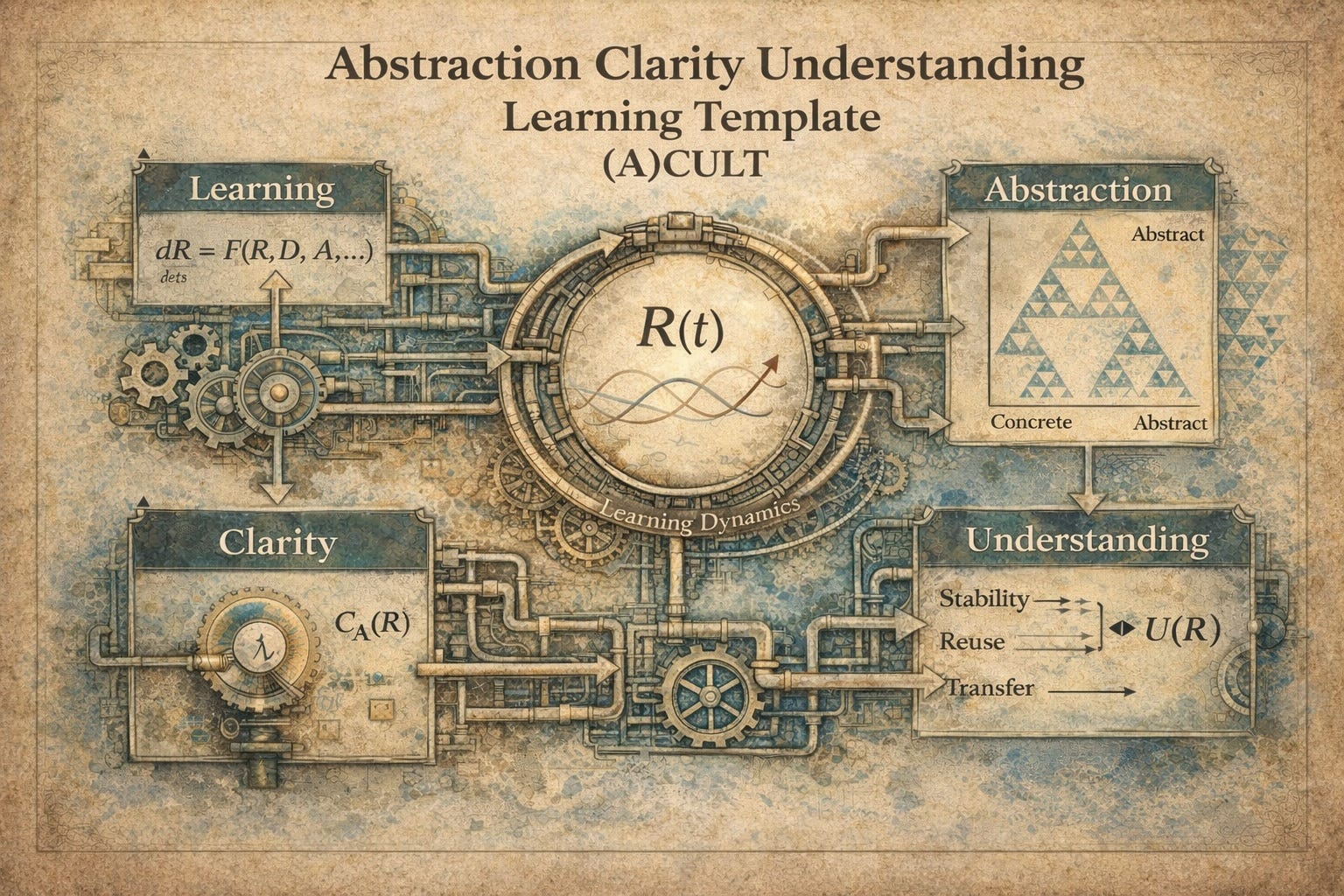
ACULT
This brings me to ACULT (pun intended)
ACULT is a lens, a template, for thinking about learning and understanding that stands for:
Abstraction – finding what stays the same across variation, at each level, as we look at something at different levels
Clarity – the internal feeling when distinctions stop mattering
Understanding – a stable state that supports transfer
Learning – the process that gets you there
ACULT - Abstraction, Clarity, Understanding, Learning Template
The idea is simple:
Learning produces understanding by discovering abstractions that bring clarity across variation.
That’s it.